Project BOONDH Rainwater Conservation Initiative
Implemented by: Abhivyakti Foundation | Supported by: Artemis Hospitals (CSR Initiative) |Financial Implication: ₹40 Lakhs
About the Initiative
Project BOONDH is a landmark initiative in rainwater conservation implemented through the Corporate Social Responsibility efforts of Artemis Hospitals and executed on the ground by Abhivyakti Foundation. Gurugram, once an expanse of fertile fields, has evolved into a bustling urban hub, resulting in severe stress on groundwater resources. According to the Central Ground Water Board (CGWB), the district’s groundwater development stands at 212.77%, far exceeding natural replenishment levels, and is classified as “over-exploited.” Additionally, groundwater contamination has emerged as a critical concern, with substances such as uranium, arsenic, nitrates, chloride, and fluoride surpassing permissible limits.
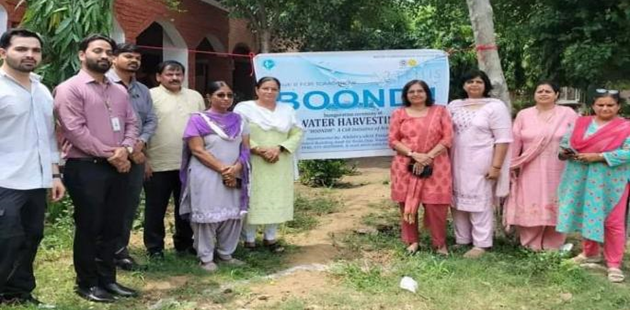
Despite these challenges, Gurugram receives an average annual rainfall of 746.2 mm, which translates to approximately 937 liters per person per day, far exceeding the standard requirement of 130 liters per person per day. Recognizing this untapped potential, Project BOONDH was conceptualized to strategically harness rainfall, replenish aquifers, and promote sustainable water practices through a combination of technical interventions, education, and community
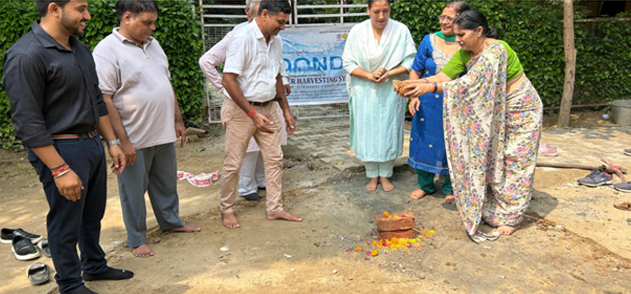
Project Approach
Project BOONDH adopts a holistic, multi-pronged strategy comprising infrastructure development, educational outreach, and community engagement to tackle water scarcity in Gurugram.
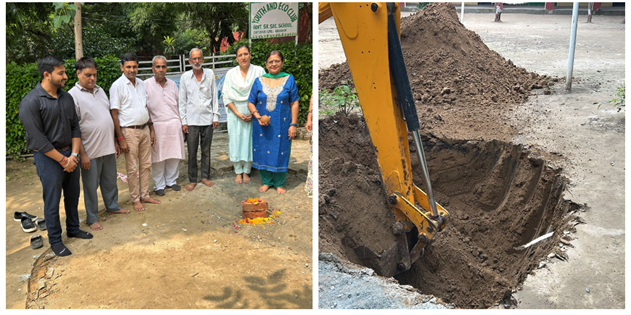
Infrastructure Development: The project constructed 14 scientifically designed rainwater harvesting (RWH) structures across six government schools and one community park. Each structure includes a desilting chamber, filtration chamber, and recharge well, ensuring both water quality and maximum groundwater percolation. These structures were integrated thoughtfully into the existing school and park environments, balancing functionality with aesthetics.
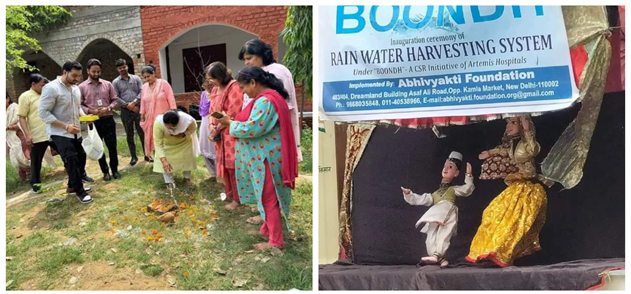
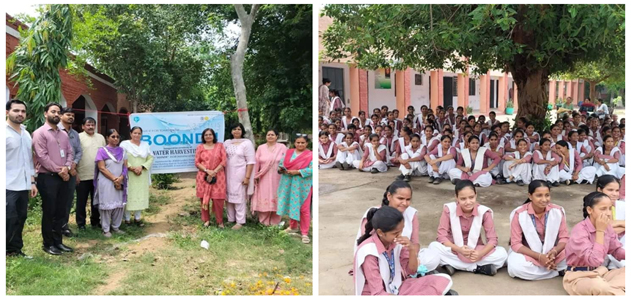
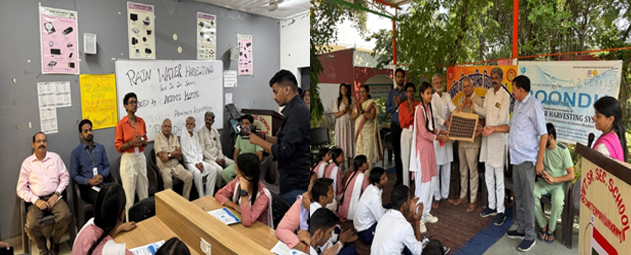
Educational Outreach: Beyond physical infrastructure, Project BOONDH placed strong emphasis on awareness and capacity-building. Students, teachers, and community members participated in puppet shows (“Jal Ki Kahani”), creative painting competitions, and interactive workshops that explained the principles of groundwater recharge, water conservation, and the “5 Rs of Water Conservation” (Reduce, Reuse, Recycle, Recharge, Respect). Live demonstrations of RWH construction and maintenance further reinforced practical understanding and long-term engagement.
Community Engagement: The project actively involved local stakeholders including school authorities, Panchayats, and resident welfare associations to promote ownership and ensure sustainability. Awareness sessions have inspired a shift in behavior, with over 70% of households adopting water-saving measures post-program.
Implementation Process
Site Selection: Sites were strategically chosen based on water stress, catchment area potential, population served, and the possibility to function as demonstrative models for replication across Gurugram.
Construction Methodology: Construction followed a meticulous process: specialized drilling for recharge wells, excavation and reinforcement of pits, RCC slab casting with maintenance access points, installation of channelization systems, and integration of multi-layer filtration media. Careful landscaping ensured that the structures blended seamlessly into the school and park environments.
Quality Assurance: Only experienced vendors were engaged through competitive procurement processes. Dedicated engineers supervised construction on-site, ensuring compliance with technical specifications. All completed works were thoroughly documented and verified, and regular monitoring protocols were implemented to guarantee long-term performance.
Technical Specifications of RWH Structures
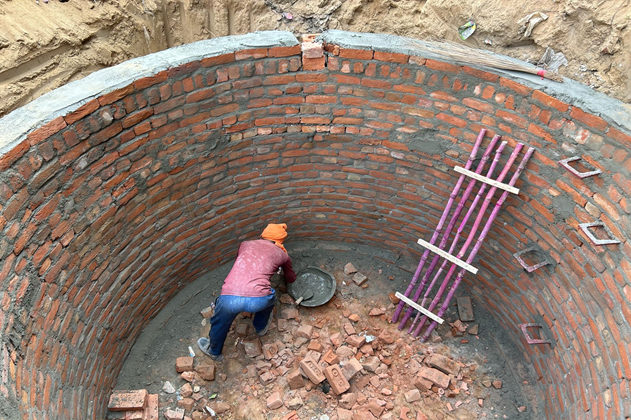
Each RWH structure was designed with three critical components:
- 1. Desilting Chamber: Constructed with RCC (M20 grade) and 230mm brick masonry walls, dimensions of 1.5m × 1.5m × 1.2m (L×W×D), a 1.5m baffle wall, and 150mm HDPE inlet pipe.
- 2. Filtration Chamber: Dimensions of 2.0m × 2.0m × 1.5m (L×W×D) with RCC construction. Contains a three-layer filtration system: 300mm pea gravel (2–4mm) on top, 300mm gravel (10–20mm) in the middle, and 400mm river boulders (40–80mm) at the bottom.
- 3. Recharge Well: 8-inch diameter borehole with 4-inch PVC pipe insertion. Pea gravel filling prevents clogging and ensures maximum water percolation into the aquifers.
Project Outcomes
Project BOONDH achieved significant environmental, social, and carbon impacts:
Environmental Impact: The 14 RWH structures recharge 5,040,000 liters annually, directly replenishing over-exploited aquifers and reducing groundwater depletion. Surface runoff and waterlogging have decreased, minimizing soil erosion, urban flooding, and water pollution. Schools and parks now have sustainable access to non-potable water, reducing reliance on municipal supplies. The project also supports local vegetation and ecosystem balance, maintaining soil moisture and enhancing biodiversity in urban spaces.
Social Impact: The initiative has benefited 11,627 students, teachers, and community members. Reliable water access improved sanitation and hygiene in schools, enhancing learning environments and health outcomes. Students trained in RWH maintenance act as “water ambassadors,” promoting sustainable practices in households and neighborhoods. Over 90% of participants reported behavioral change, including reduced water wastage and adoption of rainwater harvesting at home.
Carbon Impact: By reducing dependence on energy-intensive municipal water pumping and treatment, Project BOONDH generated significant climate benefits:
- Annual carbon savings: 52.8 tCO₂e
- Carbon payback period: 5.5 months
- 20-year net carbon benefit: 1,032.2 tCO₂e
- Carbon ROI: 44.3:1
The structures effectively mitigate greenhouse gas emissions while supporting sustainable water management and climate resilience.
Quantitative Achievements
| Location | No. of Structures | Annual Recharge Capacity (Liters) | Beneficiaries | Key Achievements | Govt. Sr. Sec. School, Basai | 3 | 1,080,000 | 1,017 | Reduced waterlogging, improved sanitation, consistent water supply |
|---|---|---|---|---|
| Govt. High School, Dhanwapur | 2 | 720,000 | 422 | Students trained in RWH maintenance, enhanced water awareness |
| Govt. Sr. Sec. School, Carterpuri | 2 | 720,000 | 1,399 | Reliable water availability, workshops completed |
| Govt. Sr. Sec. School, Daultabad | 2 | 720,000 | 787 | Continuous water for school activities, reduced scarcity |
| Govt. Model Sanskriti Primary School, Daultabad | 1 | 360,000 | 247 | Early engagement of students in water conservation practices |
| Govt. Sr. Sec. School, Sarai Alawardi | 2 | 720,000 | 755 | Improved hygiene and sanitation |
| Holi Park, Kadipur Panchayat | 2 | 720,000 | 7,000 | Community-wide impact, live demonstrations, awareness spread |
| Total | 14 | 5,040,000 | 11,627 | Full completion of training, recharge, and community engagement |
Key Achievements:
- 100% training completion for students, teachers, and community representatives.
- Over 90% participants adopted water-saving and RWH practices.
- Groundwater recharge improved by 35–40% in monitored catchment areas.
- Community engagement expanded the project’s impact beyond immediate sites.
Community Testimonials
- “The workshop increased my awareness about rainwater harvesting and inspired water-saving practices at home.” — Student
- “The RWH structure reduced waterlogging at our school, improving sanitation and learning conditions.” — Principal
- “Live demonstrations helped us understand groundwater recharge and water conservation techniques.” — Teacher
Key Learnings and Recommendations
- 1. Training Completion: All planned modules completed; participants now capable of independent maintenance.
- 2. Community Adoption: 70%+ households adopted water-saving behaviors, indicating strong multiplier effect.
- 3. Scaling Potential: The model can be replicated in additional schools, parks, and residential areas for city-wide groundwater recharge.
- 4. Innovation Opportunities: Smart monitoring sensors could improve efficiency and performance tracking.
- 5. Impact Tracking: Regular post-monsoon evaluations will measure recharge efficiency, behavior change, and system sustainability.
Conclusion
Project BOONDH represents a high-impact, scalable model of urban water management. By integrating engineering solutions, education, and community engagement, it has achieved measurable benefits: 14 functional RWH structures, 5,040,000 liters annual recharge, 11,627 beneficiaries, improved sanitation, behavioral change, and substantial carbon savings. The initiative demonstrates how corporate CSR, technical expertise, and grassroots implementation can collectively deliver sustainable change, benefiting both communities and the environment, while contributing meaningfully to SDG 6 (Clean Water and Sanitation) and SDG 13 (Climate Action).